Tuesday, March 1, 2011

Let's Talk Duck.

There are many types of ducks out there, all of which are cute, many of which are tasty.  But not all ducks are equal in the kitchen.  So let's get our ducks in a row.


This is the Mallard.  He is most often seen quacking around in ponds.  We don't usually eat him, unless we hunt him ourselves in the wild.  Most wild ducks descend from the Mallard.


This is a Pekin duck.  He is a very domesticated descendant of the Mallard.  He is most often seen on farms and hawking car insurance.  Pekin ducks are usually seen in Chinese cuisine.  They are also what you are likely to find frozen in most large, chain grocery stores for relatively inexpensive prices (though high quality Pekin can be quite pricey).  Though he looks plump and juicy, you won't get as much meat off of him as you think you will.  Pekin duck is ideal for very slow roasting: it has a lot of fat content throughout the meat that takes time to work its way out.  The meat is paler and it is the mildest tasting duck, which to me translates as the blandest.  It's often served with rich sauces.  Some people think it's more forgiving in the kitchen, but I find it easily become too greasy and I'd rather take a risk for a better outcome.


This handsome fellow is the exotic Muscovy duck, hailing originally from the Americas.  Doesn't he look like a bit like our other big bird, the turkey?  He is much more distantly related to the Mallard than other ducks we see.  Muscovy ducks are considered the gamiest tasting of all ducks; their meat is dark, lean, and often compared to beef.  It is the hardest duck to find for eating and you will pay the price.  I have yet to eat a Muscovy for this very reason.


This is the Moulard duck.  The mule of the duck world, he is a cross between a female Pekin duck and a male Muscovy.  This is a man-made creation (their, uh, interesting anatomy necessitates this) and the Moulard is infertile.  This is the duck that is used in most restaurants of the French persuasion.  It is my favorite eating duck.  The meat is relatively dark and lean, but it has a lovely, rich fat layer along the outside.  It is gamey, but not overwhelmingly so.

Often on restaurant menus, you will see "Duck Magret".  This very specifically refers to the breast meat of Moulard ducks that were used to produce foie gras (as most Moulard ducks are).  As ducks are more docile and take up less room than geese, they are now more commonly used for foie gras production.  This fattens the ducks up quite a bit, producing large, meaty animals.  So, yes, that means that if you've ordered duck in a restaurant, you've likely eaten a result of the foie gras practice, even if you turned away from the pate in objection.

Duck magret is usually found in butchers and specialty shops.  It is worth seeking out.  If a recipe calls for duck magret, you can't simply substitute Pekin to achieve the same results.  The dish might work enough, but it won't be as good.  Expect to pay $10-13 per pound for duck magret.  A one pound breast easily feeds two people.

Now on to the cooking!
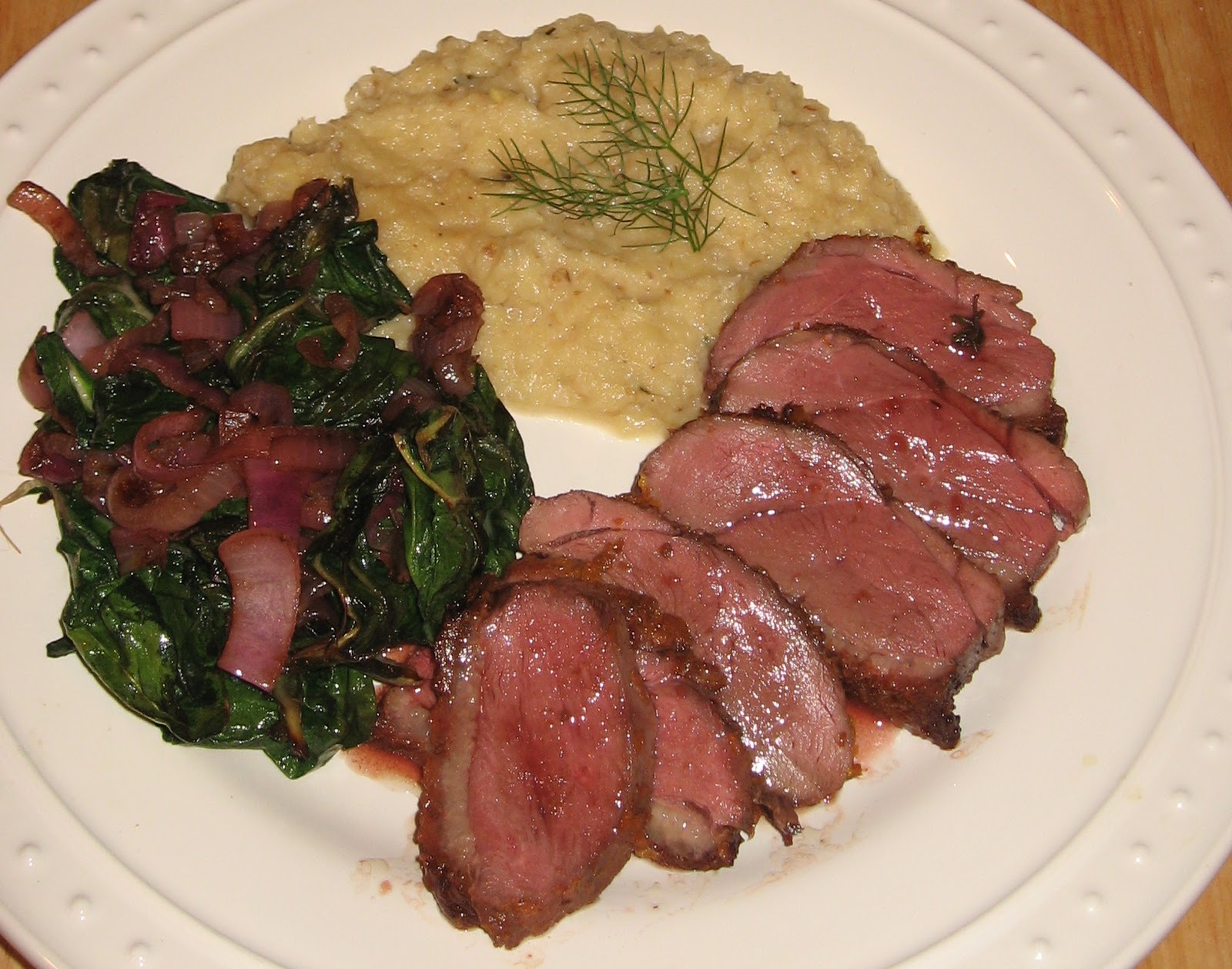

As promised I will re-visit the Martha Stewart recipe I used for Valentine's Day, found here.  But first, let's go over some duck basics.
  1. Score the fat.  You want to use a sharp knife to cut about halfway through the fat in a diamond pattern.  This will help render the fat out of the breast and create a delicious, crisp exterior.  Be careful not to cut all the way down to the flesh.
  2. Render the fat.  In my experience, duck magret does best when started on the stove top.  That direct heat renders the fat most efficiently and successfully.  Now, you aren't trying to melt all of the fat away.  Rather, your goal is to reduce the fat, fully cook what remains, and create a crisp skin.
  3. Don't you dare overcook that duck.  Duck is not chicken!  Many people freak out and think that because you completely cook chicken and duck is poulty any little tinge of pink in duck is going to kill them.  No!  Don't think that!  Duck should not be cooked above medium (it's considered red meat, so treat it as such).  Some people like it quite rare.  I myself prefer it to hover right around medium-rare.  Look at the photo above (it does have some pomegranate sauce over it that gives it a slightly pinker tinge, but not much).  The meat is a solid rich pink.  It is evenly cooked all the way through, just enough to eliminate that sort of translucent rawness that would remain if it were a bit more rare.  Cooked like this, the duck will be tender and flavorful.
On to Martha's recipe:
  • She says to marinate the duck at least a half hour.   I marinated mine a full day.  While duck magret is delicious in its own, marinading it for 24 hours made it so outstanding.  The flavors permeated every bite without overwhelming.  It was floral in the best way and complemented the meat so perfectly.  This will be my go to duck recipe from now on.
  • Martha used ground fennel.  I had fennel seeds, so I chopped them and used that and it worked well.
  • I didn't have coriander, so I left that out.  I think I put just a tiny sprinkle of dried thyme because I felt guilty.
  • It's not listed in the ingredients, but the directions call for dried lavender.  It sounds weird, but it was so good.  Find dried lavender!  If you absolutely can't find it, use some herbes de provence, which usually has some, (and make a note to buy a bag of lavender at the farmers' market this year).  I think I used a rounded half teaspoon for just under two pounds of meat and I chopped it up a bit first.
  • I didn't mix the spices together first.  I put the spices on first, then covered them with salt.  I think this worked well to lock the flavor in?  Also, I know this seems like a lot of salt, but do it.
  • I zested the orange onto the meat, then just pressed who sprigs of thyme on top, then covered with plastic wrap.  The sprigs were removed before cooking.  The thyme flavor wasn't too noticeable, (though it was there).  While you could pick the leaves off the thyme and mix it with the zest, I quite liked the thyme taking a back seat here and I don't think I would have liked the texture of the leaves left on the meat.  I might try it next time, though.
  • I used a cast iron skillet to cook the duck.  It worked beautifully and my pan was so well seasoned after.  A heavy stainless steel pan would work fine, but I feel like cast iron exists for this recipe.
  • I cooked my duck on the stove top for a solid 15 minutes.  It could have gone a few more if you like a slightly thinner fat layer.  This fat is really tasty, though.  It absorbed the marinade flavors so well.
  • Woah, Martha!  Four minutes in the oven?  I left mine in for 8.  Many people would want to go 10 or 12.
  • Do let your duck rest before slicing.
  • SAVE THE FAT!  Seriously.  There will be a major pool of melted duck fat left in your pan.  Put it in a jar and put it in your fridge.  You might want to run it through a strainer to get any larger chunks of debris out, otherwise it will just sink to the bottom.  This fat is so flavorful, you will want to use it in everything.  Definitely try frying some potatoes and using it in a dressing for a warm frisee salad.
There.  Now you know just about everything I know about duck.  Promise to use this knowledge only for good.

Happy quacking!

Sunday, February 20, 2011

Will you be my Valentine?

Ah, Valentines Day.  What, you think it's silly?  Well I do, too.  But it's also a great excuse to go all out in the kitchen.  And let me tell you:  I know how to do it right.


First and most importantly you have to have a plan of attack.  I chose to go a more formal route with several plated courses.  Know what you are capable of and what you will enjoy making: there's no shame in one simple, well-executed dish.  Make sure not to over-burden yourself or your dinner will end up more stressful than romantic.

Start by making a list of everything you want to make.  Include each separate element and step.  If you are making a pie, list making the pie crust, making the filling, and baking it.  Determine which steps can be completed ahead of time.  Write out every ingredient you need.  Double check what you already have and cross out what you don't need to buy.  Do your grocery shopping the day before and get started with as much meal prep as possible.  You don't want to spend all of your time in the kitchen and leave your Valentine waiting alone.  Beyond the actual food, make sure to set aside time to set the table, clean up some of the messes you've already made, and get yourself ready.  Now that you have an idea of how long everything might take, add an hour.  Seriously.  If you don't end up needing it then you can sit down, relax with a glass of wine, and look like the ultimate at-ease hostess when your guest arrives.

Now, on to the food!

1.  The Appetizer  (sorry, no picture)
Keep it simple: just a couple of easy to put together bites to take the edge off your hunger. 
- Slices of baguette topped with a tapenade of chopped green olives, sun dried tomatoes, and olive oil.  The spread can be made the day before.
- Crispy pancetta rounds with a few crumbles of blue cheese


2.  The Salad
This beet, orange, and fennel salad looks like a fauvist masterpiece on the plate.  Its beauty masks its easy preparation.
- Thinly slice one orange and remove peels.
- Scrub and thinly slice one beet (well, part of a beet, you probably won't need all of it).
- Fan the oranges and beets onto the plate.
- Remove the stalks from one fennel bulb and outer layer of bulb, if damaged.
- Quarter the bulb and cut away the core.
- Thinly slice the fennel and toss with salt and pepper.
- Place a neat pile of fennel in the center of the plate
- Garnish the oranges and beets with a few thin slices of shallots and some fennel fronds.
- Drizzle salad with a vinaigrette of good quality olive oil, orange juice (squeezed from the end slices), a little balsamic, and salt.


3. The Entree
Part One:  Seared Duck Breast with Pomegranate Sauce
I found the original recipes through Martha Stewart here and here.  I mostly followed the recipes, but I will do a separate post including the details.

Part Two:  Parsnip and Celery Root Puree
- Earlier in the day, scrub two parsnips and peel one small celery root.  (Don't get those mega-parsnips.  They should be the size of a normal carrot, more or less.)
- Chop them into half-inch cubes.
- Sautee in a large pan with 1 tablespoon butter  and a generous dash of salt until completely tender.  You should be able to easily mash a piece with a fork.
- Send them through a ricer (preferred) or mash by hand.
- Set aside until you are cooking your duck.
- While the duck is browning, warm the riced roots with 1 tablespoon butter, 1 tablespoon cream, and milk added until desire consistency is reached, stirring to achieve smoothness.  Season to taste with salt and pepper.

Part Three: Swiss Chard with Caramelized Red Onions
- The day before (or that morning), slice one small red onion.
- Add to a pan with a drizzle of olive oil and saute on medium-low heat until completely wilted and caramelized.
- Add a drizzle of balsamic vinegar and toss until liquid has evaporated.
- Set onions aside (refrigerate over night).
- While duck cooks, wash and remove the spines from one bundle of swiss chard.  Tear into palm sized pieces.
- Sautee in a pan with a drizzle of olive oil and a pinch of salt.
- When leaves are wilted, stir in red onion.


4.  The Dessert: Spiced Chocolate Souffle with Cardamom Creme Anglaise
I used this recipe for the souffle, as I had made it successfully a few weeks ago, simply adding 1/4 tsp. cayenne pepper.  I found this recipe for the creme anglaise.  I halved the souffle recipe and quartered the creme recipe, and the amounts were perfect (though the creme would keep several days and you'll wish you'd have made more).  The creme anglaise can (and should) be made the day before.  I also chopped my chocolate the day before, (it takes longer than you think it will).  The souffle mix can be made earlier in the day.  I made mine as the last bit of prep work before my valentine arrived.  The time it takes to bake the souffle after finishing your entree is perfect for holding hands while sipping on wine.

Happy Valentines and Happy Anytimes!  Enjoy!

Friday, February 4, 2011

Breakfast for Dinner


Breakfast for dinner doesn't have to mean maple syrup.  Rather, it can be a source of inspiration that you transform with more traditional dinner flavors.  With a surplus of rejected brioche and a late dinner requiring hungry haste, I threw together a savory French toast.

Slice the brioche or bread, preferable a tad stale.  Whisk together an egg (those who like eggs may want two) and a cup of milk.  Season with salt, pepper, thyme, and 1/4 tsp mustard (something good and spicy, not the yellow stuff).  Fresh herbs will impart a brighter flavor.  Place the slices in a shallow pan, pierce them all over with a fork, and pour the egg mixture over.  Let the slices soak at least 5 minutes, turning over once.

While they soak, start heating a heavy pan over medium.  Also slice some cremini mushrooms and set them aside.  Add a small slice of butter to the pan, then add the bread slices.  There should be a slight sizzle.  After about 3-4 minutes, turn the slices and cook for another 3-4 minutes.  They should be browned on both sides.  Remove them from the pan and set aside.  Add another small slice of butter, then add the mushroom to saute.  Add a dash of salt and cook until they are lightly browned.  Spoon the mushrooms over the toast and serve immediately.

Brioche French toast isn't exactly the lightest of dinners, so serve it with a simple salad with lemon vinaigrette and/or some fresh sliced fruit.  Oh, and I won't tell if you have this for breakfast-breakfast.  Maple syrup is overrated.

Saturday, January 29, 2011

Lima Bean Soup, or the Fastest Soup Ever


Isn't it pretty?  I'm a sucker for any spring green foods, especially in the middle of a particularly snowy winter.  This is a great soup for when you don't have time (or didn't think ahead enough) to have a soup on the stove all day long.  Creamy and filling, it's a wonderful winter soup.

- Dice a small onion and mince one clove garlic.
- Sautee in a pan with a little butter until translucent.
- Add salt, pepper, and about 1 cup baby frozen lima beans.
- When lima beans are tender, add 1 tbsp butter.
- When butter is melted, add 1 tbsp flour.  Stir well to incorporate butter with flour to make a roux.
- When the butter-flour is thick and slightly golden, add 1 cup chicken broth.  You could use vegetable broth to make it vegetarian, but beware store bought broths that are often very tomato-y.  Bring to a boil.
- Let cool slightly, then carefully transfer to a blender.
- Puree until smooth (or desired consistency).
- Optionally, add just a dash of cream for extra decadence.
- Serve hot with toasty bread for dipping.

If you wanted to be cute, you could served the bowls with a dollop of plain yogurt and a few sauteed lima beans in the center.

Friday, January 28, 2011

The Lost Recipes

I cook a lot.  Sometimes I use recipes, more often I improvise.  When I'm creating something new I try to document it.  I take pictures, I write down recipes....  but not always.  All too often I let myself think, "Oh, I'll remember.  It was so easy."  Or perhaps, "I'll write it down after dinner, or first thing tomorrow," and somehow it's five months later and the page is still blank....  ahem.  So, without further excuse, here are some of the lost recipes, may they rest in peace.

This risotto had cremini mushrooms, swiss chard (from my garden!) and...  some other stuff.

A delicious sunday brunch of bacon, pear and citrus fruit salad, and....  some kind of bread pudding.

 Lemony couscous with peppers... or tomatoes?  wilted arugula, and broiled jumbo shrimp.

This was really good.  Rice noodles with beef, onions, celery, and baby bok choy in plum sauce.  The red skin of the plums gave everything a pretty pink tinge.

 Barbeque chicken leg, homemade sauce and all, with broiled green beans.

Pizza topped with olive oil, sweet onions, garlic scapes(?), chick peas, and feta or goat cheese.

Broiled chicken(?) with kale chips and cucumber salad with yogurt dill dressing.

The moral of the story is to keep pen and paper handy when you're cooking...  or just be prepared to try to make everything all over again.  Oh, darn.
